View attachment 116971
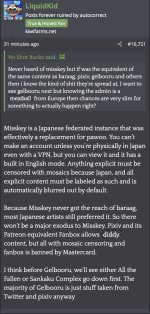
I'm sure the latter two probably use separate social media sites to hide their identity, unlike the guy that basically doxxed themselves because they were an idiot. But you know how it is. I’m sure this Kirby rip-off isn't hiding anything in his closet.
So I've been looking more into the drama with Baraag and the only thing I can say here, the Kiwiniggers are probably going to be the ones that will result in the largest First Amendment constitutional showdown in America since Joseph Burstyn, Inc. v. Wilson (1952) here (which is the Supreme Court ruling that said movies are protected speech and this acted as the final nail in the coffin for Hay's Code in America).
I said it once to myself that when I saw anime and manga going mainstream, the larger that Japanese soft power is growing the more it will butt heads with Western obscenity laws and corporate norms (and the way I see it, many Western obscenity laws will someday fall because you kinds need autocracy to staunchly enforce them anymore in liberal democracies; you need nations like the U.S. to become totalitarian to keep those obscenity laws in place to not risk many of them getting struck down which is something most Americans and most Westerners in general are not down for). Many of the obscenity laws in place in many Western nations were in place long before Japanese content went mainstream but none were prepared to handle the age of the Internet (because a lot of those obscenity clauses require local community guidelines and platforms like the Internet is borderless).
Now according to the charges, the guy that owned Baraag has been originally charged for being in possession of CSAM (he's being charged with possession of the real thing and possibly any content that looks just like the real thing) but the feds seized the domain itself under standard CSAM obscenity protocol (it is unknown if the back end itself has been seized, most likely whoever ran the back end operated it outside of America and pulled the plug before the feds could get any useful information).
And I get the strong feeling many of those free speech and tech organizations (like FIRE or FALA or the Comic Book Legal Defense Fund or NetChoice or the EFF and so on) are most likely looking at this case as it went viral online (I've even seen my share of 4channers claim they've sent emails to these free speech and tech organizations about this case so most likely these non-profit organizations now know about Baraag and what it was and why this has been a mess).
If these First Amendment and Tech organizations do decide to take on this case, it won't be to defend the Baraag owner (civil rights organizations have made it very clear they will not contest CSAM charges) but they will however fiercely contest anything that could be in conflict with the First Amendment.
Just to give you an idea of how far that these free speech organizations will go to defend the First Amendment, I've already mentioned this here but earlier this year a man from Wisconsin was charged with CSAM including being charged with AI-generated obscenity involving the deception of minors. But the Wisconsin man's lawyer was in contact with FIRE (aka the Foundation for Individual Rights and Expression) to get the AI obscenity charges dropped by using the Supreme Court's Ashcroft v. the Free Speech Coalition precedent (which states that virtual child porn is legally protected speech so long as no real kids are involved and is fictional). The criminal defense lawyer involved in this Wisconsin man's case used this to successfully convinced the 7th Circuit Court of Appeals to drop the AI charges under Supreme Court precedent and the 7th Circuit agreed. The DOJ was furious when the 7th Circuit did this and they've appealed but the 7th Circuit denied the DOJ's appeal afterwards. The CSAM charges are still moving forward but the AI obscenity charges for this Wisconsin man are now dead in the water. FIRE intervened with a criminal case and got a federal court to drop some of the charges over constitutional grounds (this happened this year by the way).
So what does this mean for the owner of Baraag? Most likely if he was in possession of CSAM then no free speech or tech organization is going to contest that. But for Baraag itself? They will probably act as a friend of the court and file lawsuits to fiercely contest how both the State of Texas and the Fed handled the seizure.
If this becomes a constitutional showdown (and it's looking like it is), many hard questions will be asked in the courts.
1. Does the government have a right to shut down an entire online platform just because there is some contraband on it and most of the content is still legally protected speech? We've seen this before in America with books where back then the American government was able to use broad forfeiture laws to shut down entire book stores because of some contraband on the shelves until the Supreme Court ruled that the government cannot shut down legally protected speech as collateral just to enforce the law (see Fort Wayne Books, Inc. v. Indiana (1989) for this). Does Fort Wayne Books, Inc. v. Indiana now also apply to the Internet? That is a hard question that is going to be asked in the courts someday.
Baraag did had some questionable content but it also contained a lot of legally protected speech too before its shut down. This kind of hard question will be asked in the courts if a case like this goes that far.
2. Do broad obscenity laws in this day and age even make sense in a world where Family Guy, The Simpsons, South Park, and Big Mouth exists now where fictional minor characters are often put in sexual or suggestive situations in those productions? Should Fox, Comedy Central, and Netflix be held accountable for the creation of those productions in the first place?
I'm old enough to remember a time when Beavis and Butthead and Grand Theft Auto were considered obscene because Beavis and Butthead were two idiots that did retarded and dangerous things on television (which caused a lot of retarded boomers at the time to see the show as obscene influence on kids) and Grand Theft Auto was condemned by being accused of teaching kids how to commit a crime. Roughly 20 years later have passed and now Beavis and Butthead is a celebrated American icon and most of the 'muh-Video games causes violence' rhetoric has largely died down since then.
The exact same thing is happening with Japanese content. In the past few years, anime and manga have gotten really big in America and is no longer this niche thing anymore (the fact that I now see those Pokemon trading card game kiosks in supermarkets these days shows how America is quickly becoming Japanified now).
But the byproduct is that even the more degenerate aspects of Japanese pop culture are also quickly being imported into America too such as lolicon and shotacon content (far faster than what the American government can catch up with).
Malcolm from Malcolm in the Middle said it best, "You can't beat the system but you sure can break it" and the way I see it, Japanese pop culture being more widespread in America and in the Western world in general won't beat the system but it's sure as Hell is going to break that system someday.
There was a point in time when movies weren't seen as protected speech until it did (see Joseph Burstyn, Inc. v. Wilson (1952) for this), there was a point in time when people didn't saw violent video games as protected speech until they were granted this legal protection (see Brown v. Entertainment Merchants Association (2011) for this), and it appears to me that Japanese pop culture is going to have its day in court one of these days and will ask this exact same question to the Supreme Court one of these days.
If any of the Kiwicucks are by some chance reading this, you're going to find out pretty quickly on why America doesn't really have retarded Euroepan-styed speech regulation laws in the first place. Because the Lolicons and the Anime community in general aren't going to argue with you to gain victory (because arguing with sub-80 IQ moralfags is a complete waste of time), they're going to fight this in the federal court system instead with top of the line lawyers to defend their right to freedom of expression. So go ahead, snitch on some Literately Whos that make weird or degenerate shit and your snitching may lead to a constitutional showdown that will most likely backfire on your moralfagging someday and the rest of the Internet will laugh at you when they see your moralfagging may result in the Internet being more free and open anyway.
Because I'm going to laugh if Kiwi Farms and other similar moralfagging platforms are probably going to be the reason the federal court system narrows down the really broad obscenity statues and forfeiture laws anyway.