
Boobie Bomb
An Onion Among Onions
Pretty soon, Null will have no more mods left if they keep on quitting like flies. I'll be shocked if he finally closes down his website for good.Trombonista is now an Ex-Janny
View attachment 113107

Pretty soon, Null will have no more mods left if they keep on quitting like flies. I'll be shocked if he finally closes down his website for good.Trombonista is now an Ex-Janny
View attachment 113107

I wouldn’t be surprised if this or something alot like it happens this decade.Pretty soon, Null will have no more mods left if they keep on quitting like flies. I'll be shocked if he finally closes down his website for good.
Fyi she did this because someone called her work and now she thinks stepping down from her fake authority position on a website that has its own wikipedia page about how many people it's killed and stalked including children will sever the association. That rumored Ashkenazi IQ boost seems to have missed this one.Trombonista is now an Ex-Janny
View attachment 113107


Your understanding confuses valid observations about poor website design with incorrect legal conclusions and misses the point on intent and harm of the follow up actions.Most websites now or formerly show everyone's email address by trying to request a new password. That is not a crime, that is just taking advantage of what should not even be there to begin with. And that does not even include those who forget to hide their email address when they sign up to anywhere.
Calling Kiwi Farms a website full of criminals is stupid because it makes them sound like a website full of badass leet haxxers persecuted by trannies and liberals, just like they imagine themselves as. That is the main image Kiwi Farms wants to project to everyone (when they are not trying to portray themselves as the last bastion of free speech), though in reality Kiwi Farms is a website full of hypocritical boomers where some people know one simple trick that only exists because people are stupid, people coding social media and government websites do not give a fuck, and American corporations can legally sell all sorts of private data.

Stop. "Not a stretch to argue" =/= illegal. Show some actual proof that it is illegal like an actual court case.It is not a stretch to argue that submitting someone else's username that does not belong to you into a "forgot password" or similar account recovery flow to elicit information that does not belong to you is not passive observation of public data.
No. You are disingenuous and I am calling you on your shit.Stop. "Not a stretch to argue" =/= illegal. Show some actual proof that it is illegal like an actual court case.
Same thing with finding data publically accessible sites or using loopholes in government databases. None of that is a crime, and there have been a number of court cases that omit such behavior from the law. What is a crime, in some jurisdictions, is doxing, so at best you have conduct that is not inherently illegal but can be used to prove a crime.

Wouldn't be surprised, he's constantly encouraging the retarded political shitflinging across threads due to his TDS.Chingtastic Chong is next.

I never liked him good riddance but it won't save the site.Fyi she did this because someone called her work and now she thinks stepping down from her fake authority position on a website that has its own wikipedia page about how many people it's killed and stalked including children will sever the association. That rumored Ashkenazi IQ boost seems to have missed this one.
Don't worry lil Zionist you're 35 living with daddy and stock produce at Jewel-Osco, I'm pretty sure that kind of tard work is the only career you wouldn't
Who posted this tripe?! KF has all kinds of illegal material on it!i love how so many users on green reddit are retarded. like people just fucking forget that you can see lolcows nude pics and sex tapes and stolen Onlyfans content
View attachment 113114
this is what i hate about the user base, because they mostly care only about politics they don't seem to realize all the illegal shit kiwifarms has been a part of, like the animal torture or sex tape stuff still on the hard drives of the farms. these retards come up with this image of the site that anyone with a spine would call out but no one will because no one wants to admit how bad the site really is.I never liked him good riddance but it won't save the site.

how do you know this?she did this because someone called her work
how do you know this?
Stop legitimizing this freaks mental illness, stop calling a man a woman!Sarah made the strange decision to keep a LinkedIn page while simultaneously doing unpaid work for what might be the most hated website in existence.
Which is itself confusing since LinkedIn is mostly for educated professionals to network, and all Sarah has done her entire life is grocery stocking jobs that people with literal brain injuries get hired for.
So nothing was stopping a person from calling her store and requesting to speak to her because she (reportedly) found a missing item of theirs in the parking lot. And then say her nazi site handle out loud which caused her to audibly freak out and hang up.
Basically there's a lot of questions about her sanity and decisions when running a literal suicide-causing revenge porn site, but also what I'm gathering from her retirement from the suicide baiting and revenge porn site thread is she was really really nice. She was about as heckin wholesome as all the house stealing baby murdering kikerinos who didn't tell her she was ugly and stank (in English) when she visited them for a week. And that's what's important. Being nice.
View attachment 113118
That was not your argument. You were claiming that finding emails from data breaches (which the "reset password" feature is emphatically not a data breach and that is the most common) to find publically available information makes you a cybercriminal. I am not buying your motte and bailey nonsense that you were actually talking about doxing, which we agree is a crime. Resetting passwords and accessing voting databases and publically accessible info is, as we agree, perfectly legal and does not violate any laws. It is as relevant to doxing being illegal as driving at certain times of day is to being a drug trafficker, in that the only reason you would bring it up is if you are an attorney looking to prosecute someone for an actual crime.No. You are disingenuous and I am calling you on your shit.
What gets missed in your "show me the statute/case" argument is that no one is claiming a password reset probe, database lookup, or a forum post is automatically criminal on its own. The point is the assembled pattern of conduct and what it is being used to accomplish, which you yourself just admitted is a crime.
Stop treating each step as isolated trivia ("just a lookup", "just public data", "just posting", "just a boomer trick") and start recognizing it as a small piece of a whole process- Doxing. Doxing is a combination of behavior in a completed form, and Kiwi Farms users are habitual offenders of it. You can argue that, at its face, IF isolated, it is not. But you miss the forest for the trees. WHY do they do it? To get someone's personal information. Why do they want that personal information? To dox them, shame them, humiliate them, harass them, or in some cases even threaten them.
You can break it down like this:
snip

I'm starting to see people shit up the thread again, could we please not do that.
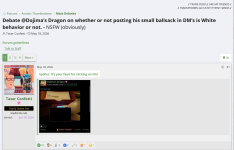
Kiwifarms is basically a private messaging site with a small public area. USPG2 is the site's FYAD part, where the users laugh and shitpost, before getting into the spicy chats in DMs, numerous users have been caught sharing porn, hentai, and especially lolicon in DMs. Even worse is them sending pictures of their genitals to each other. Null allowing the users to do such things while complaining about fucking Capcom games makes him look like a gigantic retard.
View attachment 112857
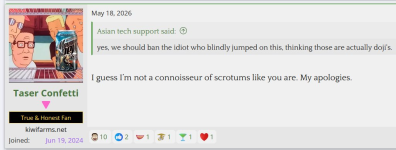
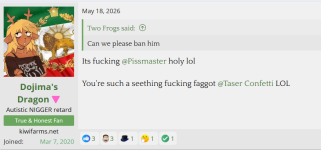
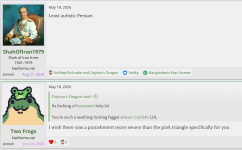
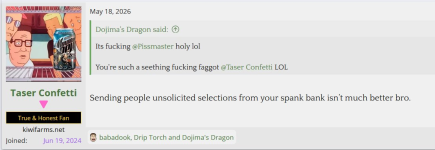
thats such a fucking lie, there's a reason Null called on her to fix the Chud The Builder thread. Trom was perfectly fine sweeping for a guy who hated everything about her, on a site that hated everything about her except her being a jew.Basically there's a lot of questions about her sanity and decisions when running a literal suicide-causing revenge porn site, but also what I'm gathering from her retirement from the suicide baiting and revenge porn site thread is she was really really nice. She was about as heckin wholesome as all the house stealing baby murdering kikerinos who didn't tell her she was ugly and stank (in English) when she visited them for a week. And that's what's important. Being nice.

free speech forum my ass, oy vey!Null said she was responsible for deleting any racist messages on kiwifarms
