
Here, this is the MATI I was referring to where Null played the Irish song and referred to St Patrick's Day as "one of the many Fuck England days":
Final Moments (March 18th, 2022) - Mad at the Internet
https://odysee.com/@mati:c/mad-at-the-internet-2022-03-18:4
Here's the song he played, but this is a cover, not the original:
Contrary that what I thought it isn't about the Irish fighting the British but about anti-Royalists fighting Royalists, so it's about in-fighting amongst the Irish themselves. ("the song itself is a dispute between republican and unionist neighbours in inner-city Dublin in the Irish Free State era of the mid-1920s.")
Final Moments (March 18th, 2022) - Mad at the Internet
https://odysee.com/@mati:c/mad-at-the-internet-2022-03-18:4
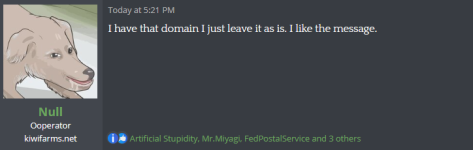
"Yesterday was St Patrick's Day, which is celebrated more in the US than in Ireland, there's more, like, Irish descendants in the US than in Ireland. But, uh, I consider St Patrick's Day one of the many "Fuck England" days that exists on the calendar that I keep track of. And all those holidays put me in good spirits. Anything that is just decisively, "you know what? England can go fuck itself", that is a cause for celebration. Though, I don't know, Ireland has its own problems." - Null.
Here's the song he played, but this is a cover, not the original:
Come Out, Ye Black and Tans is an Irish rebel song referring to the Black and Tans, or "special reserve constables" (mainly former World War I army soldiers), recruited in Great Britain and sent to Ireland from 1920, to reinforce the Royal Irish Constabulary (RIC) during the Irish War of Independence.[1][2] The song was written by Dominic Behan as a tribute to his Irish Republican Army (IRA) father Stephen,[3] who had fought in the War of Independence, and is concerned with political divisions in working-class Dublin of the 1920s.[1] The song uses the term "Black and Tans" in the pejorative sense against people living in Dublin, both Irish Catholic and Protestant, who were pro-British.[2][1] The most notable recording was in 1972 by the Irish traditional music group The Wolfe Tones, which re-charted in 2020.[1]
https://en.wikipedia.org/wiki/Come_Out,_Ye_Black_and_Tans
Contrary that what I thought it isn't about the Irish fighting the British but about anti-Royalists fighting Royalists, so it's about in-fighting amongst the Irish themselves. ("the song itself is a dispute between republican and unionist neighbours in inner-city Dublin in the Irish Free State era of the mid-1920s.")
I was born on a Dublin street
Where the Royal drums do beat
And the loving English feet
They walked all over us
And every single night
When me da would come home tight
He'd invite the neighbours out with this chorus
Come out ye Black and Tans
Come out and fight me like a man
Show your wife how you won medals down in Flanders
Tell her how the IRA made you run like hell away
From the green and lovely lanes of Killashandra
Come tell us how you slew
Them ould Arabs two by two
Like Zulus they had spears and bows and arrows
How brave you faced one
With your 16-pounder gun
And you frightened them damned natives to the marrow