

Yes, looking at Surah 4:157 strictly through the lens of Modern Standard Arabic (MSA) vs. Classical Arabic can subtly alter how a reader naturally processes its meaning.
While the fundamental grammar rules and core vocabulary of Classical Arabic and Modern Standard Arabic (MSA) are largely identical, shifts in semantic range, stylistic nuance and cultural context between the 7th-century text and modern usage open up different avenues of interpretation.
The core sentence in question reads:

Here is how the shift from Classical Arabic to Modern Standard Arabic impacts the interpretation of this specific verse:
1. The Passive Verb Shubbiha (شُبِّهَ)
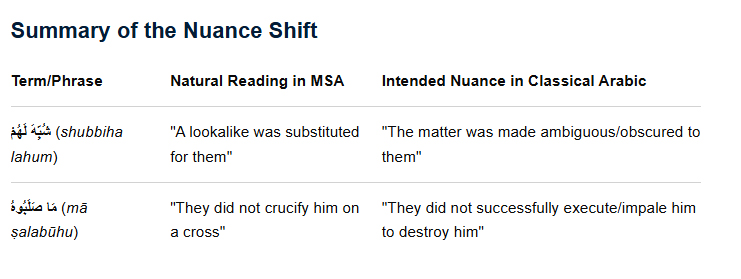
In Modern Standard Arabic: The verb shubbiha is most frequently understood in modern contexts to mean "it was made to resemble" or "it was simulated." When a modern speaker reads this, it heavily prompts the imagination toward a physical substitution—the idea that someone else's face or body was modified to look like Jesus, leading to the substitution theory common in later classical commentaries.
In Classical Arabic: The semantic scope of shubbiha in the 7th century was much broader. It literally means to make something obscure, ambiguous, or a matter of conjecture (tashbeeh). Interpreted this way, the phrase shubbiha lahum means "it was made ambiguous/unclear to them" or "the matter was obscured for them." Rather "it was made ambiguous/unclear to them" or "the matter was obscured for them." Rather than a physical clone or lookalike, the text in Classical Arabic can more readily be read as a comment on the state of mind of the executioners—they were in utter confusion, doubt, and chaos regarding what actually occurred
2. The Direct Object of the Confusion
In Modern Standard Arabic: Because MSA prioritizes straightforward subject-verb-object clarity, a modern reader naturally searches for the pronoun object. The phrase shubbiha lahum is often mentally completed as shubbiha [ʿĪsā] lahum ("Jesus was made to appear to them [as someone else]").
In Classical Arabic: Classical Arabic syntax frequently utilizes open-ended impersonal passive constructions. The phrase can elegantly mean "the situation was made to appear so to them" (an impersonal "it"). Modern academic scholars often point out that the 7th-century audience would not automatically assume a human substitute, but rather that the event or fate of Jesus was shrouded in mystery.
3. The Definition of Ṣalaba (صَلَبَ)
In Modern Standard Arabic: Ṣalaba has a very fixed, highly specific meaning: to crucify on a T-shaped or Latin cross, mimicking the Western/Christian historical understanding of Roman crucifixion. In Classical Arabic: The root ṣ-l-b carried broader connotations of binding, impaling, or exposing a body on a wooden stake or tree trunk to die publicly. In the historical context of 7th-century Arabia, the rhetorical weight of saying "they did not kill him nor did they ṣalabūhu" was a direct refutation of the specific Jewish claim mentioned earlier in the verse ("We killed the Messiah"). In classical rhetoric, it denies that his enemies achieved a definitive, humiliating triumph over him, as God vindicated His prophet.
https://www.researchgate.net/publication/394957051_THE_REALITY_OF_JESUS'_DEATH_IN_Q_4157_A_SUMMARY_OF_VIEWS_AND_A_NEW_PROPOSAL_IN_THE_LIGHT_OF_JEWISH-CHRISTIAN_CONTROVERSIES
https://www.alim.org/quran/compare/surah/4/157/
https://www.researchgate.net/publication/394957051_THE_REALITY_OF_JESUS'_DEATH_IN_Q_4157_A_SUMMARY_OF_VIEWS_AND_A_NEW_PROPOSAL_IN_THE_LIGHT_OF_JEWISH-CHRISTIAN_CONTROVERSIES
https://www.academia.edu/44934296/Who_Killed_Jesus_A_New_Reading_of_the_Quran_4_157_
While the fundamental grammar rules and core vocabulary of Classical Arabic and Modern Standard Arabic (MSA) are largely identical, shifts in semantic range, stylistic nuance and cultural context between the 7th-century text and modern usage open up different avenues of interpretation.
The core sentence in question reads:
Here is how the shift from Classical Arabic to Modern Standard Arabic impacts the interpretation of this specific verse:
1. The Passive Verb Shubbiha (شُبِّهَ)
In Modern Standard Arabic: The verb shubbiha is most frequently understood in modern contexts to mean "it was made to resemble" or "it was simulated." When a modern speaker reads this, it heavily prompts the imagination toward a physical substitution—the idea that someone else's face or body was modified to look like Jesus, leading to the substitution theory common in later classical commentaries.
In Classical Arabic: The semantic scope of shubbiha in the 7th century was much broader. It literally means to make something obscure, ambiguous, or a matter of conjecture (tashbeeh). Interpreted this way, the phrase shubbiha lahum means "it was made ambiguous/unclear to them" or "the matter was obscured for them." Rather "it was made ambiguous/unclear to them" or "the matter was obscured for them." Rather than a physical clone or lookalike, the text in Classical Arabic can more readily be read as a comment on the state of mind of the executioners—they were in utter confusion, doubt, and chaos regarding what actually occurred
2. The Direct Object of the Confusion
In Modern Standard Arabic: Because MSA prioritizes straightforward subject-verb-object clarity, a modern reader naturally searches for the pronoun object. The phrase shubbiha lahum is often mentally completed as shubbiha [ʿĪsā] lahum ("Jesus was made to appear to them [as someone else]").
In Classical Arabic: Classical Arabic syntax frequently utilizes open-ended impersonal passive constructions. The phrase can elegantly mean "the situation was made to appear so to them" (an impersonal "it"). Modern academic scholars often point out that the 7th-century audience would not automatically assume a human substitute, but rather that the event or fate of Jesus was shrouded in mystery.
3. The Definition of Ṣalaba (صَلَبَ)
In Modern Standard Arabic: Ṣalaba has a very fixed, highly specific meaning: to crucify on a T-shaped or Latin cross, mimicking the Western/Christian historical understanding of Roman crucifixion. In Classical Arabic: The root ṣ-l-b carried broader connotations of binding, impaling, or exposing a body on a wooden stake or tree trunk to die publicly. In the historical context of 7th-century Arabia, the rhetorical weight of saying "they did not kill him nor did they ṣalabūhu" was a direct refutation of the specific Jewish claim mentioned earlier in the verse ("We killed the Messiah"). In classical rhetoric, it denies that his enemies achieved a definitive, humiliating triumph over him, as God vindicated His prophet.
https://www.researchgate.net/publication/394957051_THE_REALITY_OF_JESUS'_DEATH_IN_Q_4157_A_SUMMARY_OF_VIEWS_AND_A_NEW_PROPOSAL_IN_THE_LIGHT_OF_JEWISH-CHRISTIAN_CONTROVERSIES
https://www.alim.org/quran/compare/surah/4/157/
https://www.researchgate.net/publication/394957051_THE_REALITY_OF_JESUS'_DEATH_IN_Q_4157_A_SUMMARY_OF_VIEWS_AND_A_NEW_PROPOSAL_IN_THE_LIGHT_OF_JEWISH-CHRISTIAN_CONTROVERSIES
https://www.academia.edu/44934296/Who_Killed_Jesus_A_New_Reading_of_the_Quran_4_157_
Last edited: